Fiberglass vs. Steel Service Bodies: The Complete 2026 Guide for Fleets, Contractors & Service Professionals

Choosing the right service body material is one of the most important decisions a contractor, fleet manager, or service professional can make. Whether you’re in HVAC, telecom, utilities, construction, municipal work, or mobile service, your truck body directly impacts fuel consumption, payload capacity, maintenance cycles, downtime, and ultimately your bottom line.
In North America, the two dominant service body materials are steel and fiberglass (composite). Each comes with strengths, weaknesses, and dramatically different long-term costs. SpaceKap builds its slip-in service bodies in fiberglass, and this guide explains why.
This definitive guide provides a manufacturer-level, data-rich comparison designed for professionals who depend on their trucks every day. Unlike generic blog posts, this article integrates real-world fleet concerns, material science, and technical performance factors that matter in harsh climates — snow, salt, humidity, corrosive chemicals, rough job sites, and long-haul driving.
By the end of this guide, you’ll understand:
- How fiberglass and steel perform under real working conditions
- Weight differences and the effect on fuel economy
- Corrosion risks and lifecycle maintenance
- Durability in harsh climates and industrial environments
- Long-term cost of ownership (TCO)
- Payload advantages
- How service body materials affect safety, driver fatigue, and vehicle longevity
- Which material is best for your operational needs
1. Understanding the Materials: What Are Steel and Fiberglass Service Bodies Made Of?
Steel Service Bodies — Material Overview
Steel bodies are typically built using carbon steel or stainless steel, often with a powder-coated or painted finish. Their strengths lie in raw structural rigidity and crush resistance, which makes them common in heavy-duty and industrial contexts.
Strengths:
- Very strong under direct and crushing loads
- High rigidity
- Easy to repair locally (welding, patching)
Weaknesses:
- Very heavy — often 900–1,400 lbs for a full service body
- Prone to rust and corrosion in harsh climates (salt, humidity, chemicals)
- Requires frequent maintenance (painting, sealing, rust repair)
- Additional stress on suspension, brakes, drivetrain, and tires
Fiberglass (Composite) Service Bodies — Material Overview
Fiberglass service bodies — such as those manufactured by SpaceKap Service Bodies — are built from fiberglass-reinforced polyester resin (FRP), structural laminates, with a gelcoat protective outer layer and internal reinforcements to ensure structural integrity.
These composite technologies are widely used in marine vessels, aerospace components, emergency vehicles, and high-impact industrial housings — environments that demand durability, corrosion resistance, and longevity.
Key advantages of fiberglass:
- Will never rust
- Much lighter — often 30–50% lighter than steel bodies
- Excellent insulation (temperature stability inside the body)
- UV-resistant and corrosion-proof (salt, chemicals, humidity)
- Flexible under impact — absorbs energy rather than denting
- Smooth, easy-to-clean interior
- Significantly lower ongoing maintenance
Fiberglass bodies are built for fleets that demand longevity, fuel efficiency, reliability, and resistance to North American winter conditions.
2. Summary Comparison Table
| Feature | Fiberglass Service Body | Steel Service Body |
|---|---|---|
| Weight | Lightweight (400–700 lbs) | Heavy (900–1,400 lbs) |
| Rust / Corrosion Resistance | Never rusts | High corrosion risk over time |
| Durability (impacts, dents) | High — absorbs impact, no permanent denting | Strong but dents easily, dent leads to rust potential |
| Fuel Economy | Up to 6–15% savings over time | Lower due to additional weight |
| Maintenance | Very low (wash + occasional gelcoat upkeep) | Frequent (rust repair, repainting, welding) |
| Lifespan | 12–20+ years | Typically 5–10 years depending on environment |
| Climate / Corrosion Performance | Excellent for snow, salt, humidity, chemicals | Poor in harsh / salty / humid or winter climates |
| Payload / Vehicle Stress | Lower stress on suspension, brakes, drivetrain | Higher stress — increases wear on truck components |
| Transferability | Designed to be transferable between trucks (e.g. Diablo, Wild, Compak / general SpaceKap bodies) | Often permanently mounted — difficult to transfer |
| Total Cost of Ownership (10 years) | Generally lowest | Often significantly higher due to maintenance, fuel, downtime |
3. Weight & Fuel Efficiency: The Hidden Cost Most Fleets Ignore
Weight is one of the greatest hidden expenses in fleet operation. Every extra pound on a service truck directly affects fuel economy, suspension wear, tire wear, braking distance, and maintenance costs.

Typical weights:
- Steel service body: ~900–1,400 lbs
- Fiberglass service body: ~400–700 lbs
That’s a savings of roughly 500–700 lbs when opting for fiberglass over steel.
Based on industry data, reducing vehicle weight by 100 lbs can improve fuel economy by ~1%. Translating this into fleet usage:
- Removing 600 lbs → ~6%-15% better fuel economy (depending on driving patterns)
- For a 20-truck fleet driving 20,000 miles/year, this could represent $600–$900 per truck per year in fuel savings → $12,000–$18,000 per year for the fleet
- Over 10 years, fuel savings alone may exceed the initial investment differential
For contractors and fleets operating across multiple jobs in a day, these savings accumulate rapidly and become a major competitive advantage.
4. Durability: Dents, Impacts & Real Job-Site Abuse
Steel Bodies
Steel is strong under load, but on job sites tools, ladders, or equipment often get tossed around inside the service body. In steel bodies, this often leads to:
- Dents
- Paint chipping
- Rust initiation at damaged spots
- Increasing structural weakness over time
Fiberglass Bodies
Fiberglass is naturally more flexible under shock and impact. In practice:
- Impacts are absorbed — no permanent denting
- No rust — even if scratched or gouged
- Interior stays intact longer
- Appearance and structural integrity retained through heavy-duty professional use
For contractors, this means fewer repairs, less downtime, and a more professional appearance over the vehicle’s lifetime.
5. Corrosion Resistance: Where Fiberglass Is a Clear Winner

Steel service bodies corrode over time because of exposure to:
- Salt on winter roads
- Humidity and coastal environments
- Chemicals, solvents, construction dust, fertilizers, industrial agents
- Moisture seepage, repeated wet/dry cycles
Even stainless steel can eventually oxidize under harsh conditions. For Canadian and northern US fleets — exposed to salt, ice, and moisture — this represents a serious long-term risk.
Fiberglass bodies by contrast:
- Are completely corrosion-proof
- Require no rust-proof coatings or undercoating maintenance
- Maintain structural integrity for decades
- Are ideally suited for harsh winter climates and salty roads
6. Maintenance & Repair: Cost Over the Life of the Vehicle
Steel Body Maintenance
- Sanding rust and repainting periodically
- Welding repairs after dents or structural stress
- Regular undercoating or rust-proofing
- Replacing corroded panels over time
Annual maintenance costs for steel bodies can easily reach $500–$1,200 per truck per year.
Fiberglass Body Maintenance
- Wash and clean regularly
- Inspect seals and hinges
- Occasional gelcoat touch-up (rare)
Typical annual maintenance: $50–$100. That represents a maintenance cost reduction of roughly **85–95%** compared to steel.
7. Lifespan & Long-Term Value
Steel bodies often have a usable lifespan of 5–10 years. Corrosion, rust-through, structural weakening, and aesthetic degradation often force early retirement.
Fiberglass service bodies — like those built by SpaceKap — have a usable lifespan of 12–20+ years. The same composite technology is used in marine, aerospace, and emergency vehicle applications precisely because of longevity and environmental resistance.
In many instances, a fiberglass body will outlive multiple pickup trucks, dramatically reducing total cost of ownership and environmental footprint.
8. Payload Capacity & Vehicle Stress
A lighter service body reduces wear on the vehicle’s suspension, brakes, transmission, and tires. It also reduces fuel consumption and increases payload capacity — a valuable featurewhen hauling heavy tools, materials, or equipment. This translates into fewer breakdowns, lower maintenance, and longer vehicle life.
9. Productivity, Comfort & Safety

Temperature Stability & Insulation
Fiberglass naturally insulates better than steel. In winter, tools, chemicals, and materials stay at more stable temperatures; in summer, interior heat is reduced compared with steel. This helps protect materials from freezing or overheating and preserves tool life. Professionals can also configure their workspace with SpaceKap accessories, including shelving, drawer units, ladder racks, and cargo management systems.
Noise Reduction
Fiberglass bodies absorb vibrations and sound better than metal, which helps reduce driver fatigue and improve comfort — a valuable advantage for long workdays and mobile crews traveling between sites.
10. Transferability: A SpaceKap Advantage
One of the most significant advantages of SpaceKap fiberglass bodies is transferability. A SpaceKap unit can be removed from one truck and installed on another (with the same bed length) — often in under an hour using the SpaceKap jack system or forklift. This is not practical with most steel bodies, which are usually permanently mounted.
This means you can replace a truck’s chassis or upgrade vehicles without reinvesting in a new service body. Over the lifecycle of a fleet, this dramatically lowers CAPEX and increases ROI.
11. Total Cost of Ownership (TCO) — 10-Year Scenario
Steel Body — Estimated 10-Year Cost
- Body Purchase: $7,000–$13,000
- Fuel Loss (due to weight): $6,000–$9,000
- Rust Repairs & Paint: $3,000–$8,000
- Downtime & Repairs: $4,000–$10,000
- Early Replacement / Resale Loss: $7,000–$12,000
- Total 10-Year Cost: $27,000–$52,000
Fiberglass Body — Estimated 10-Year Cost
- Body Purchase: $9,000–$16,000
- Fuel Savings (vs steel): –$6,000
- Maintenance: $500–$1,500
- Minimal Downtime
- Transferability Savings (not needing new body): $7,000–$12,000
- Total 10-Year Cost: $12,000–$18,000
In many cases, a fiberglass service body costs **40–60% less** over 10 years than a steel body.
12. Which Service Body Material Is Best for You? Choose Fiberglass if you want:
- Maximum lifespan and longevity
- No rust or corrosion — ever
- Lower fuel costs and higher payload capacity
- Minimal maintenance
- Good insulation against temperature extremes
- Less stress on your truck
- Transferability when you replace or upgrade trucks
- Better total cost of ownership over 10–20 years
Fiberglass is ideal for commercial fleets, contractors, and service companies operating across multiple job sites under harsh conditions, or in climates like Canada and the northern U.S.
Choose Steel if you need:
- A lower upfront cost
- Maximum crush or impact resistance under heavy loads
- Ease of local repairs (welding, metalwork) when repairs are needed
- A body you don’t intend to keep long-term (e.g. rental fleets, heavy industrial uses, mining)
Steel remains a valid choice in highly specialized industrial or off-road environments where metal strength and local repairability matter more than long-term cost or maintenance.
Ready to upgrade your service body? Get a quote from SpaceKap today.
13. FAQ — Fiberglass vs Steel Service Bodies
Which lasts longer, fiberglass or steel service bodies?
Fiberglass bodies typically last 12–20+ years, while steel bodies often last 5–10 years due to corrosion, rust, and structural degradation.
Does fiberglass crack in winter?
No — high-quality composite service bodies like SpaceKap fiberglass bodies are designed to withstand extreme climates. The composite stays flexible even in freezing temperatures and retains structural integrity under impact.
Can fiberglass service bodies handle heavy equipment?
Yes. SpaceKap bodies are engineered for professional contractors and can support racks, shelves, tools, and equipment commonly used in HVAC, electrical, telecom, and construction industries.
Do fiberglass bodies reduce fuel costs?
Yes. The lighter weight of fiberglass bodies can improve fuel economy by approximately 6–15%, depending on use and driving patterns.
Are fiberglass service bodies transferable?
Diablo, Wild and other SpaceKap models are designed to be fully transferable between pickup trucks with the same bed length — unlike most permanently mounted steel bodies.
Do fiberglass bodies rust?
No. Fiberglass is 100% corrosion-proof, making it ideal for salty roads, coastal climates, and harsh winter conditions.
14. Why SpaceKap Fiberglass Service Bodies Represent the Best Long-Term Investment
Steel bodies have served fleets for decades and remain an acceptable option for certain heavy-duty or industrial applications. But for most modern contractors and fleet operators, fiberglass delivers a far superior long-term solution:
- Longer service life
- No rust or corrosion
- Lower total cost of ownership over 10–20 years
- Transferability to new trucks
- Lower maintenance and fuel costs
- Improved payload capacity and less wear on the vehicle
- Better insulation and user comfort
SpaceKap fiberglass bodies are engineered for North American climates — including harsh winters, salt roads, heavy use, and long working hours. Whether you operate a fleet of 50 vehicles or a single service truck, a SpaceKap body is among the most innovative and most profitable upgrades you can make.
Ready to upgrade your service body? Get a quote from SpaceKap today. Our fiberglass units fit any make and model of full-size pickup, in 6′ or 8′ bed sizes. Start saving on fuel, maintenance, and downtime while boosting your fleet’s lifespan.
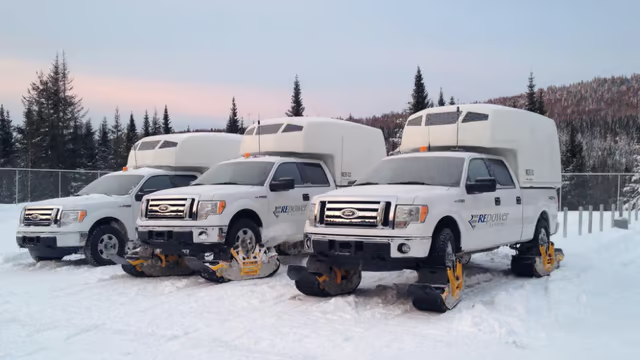
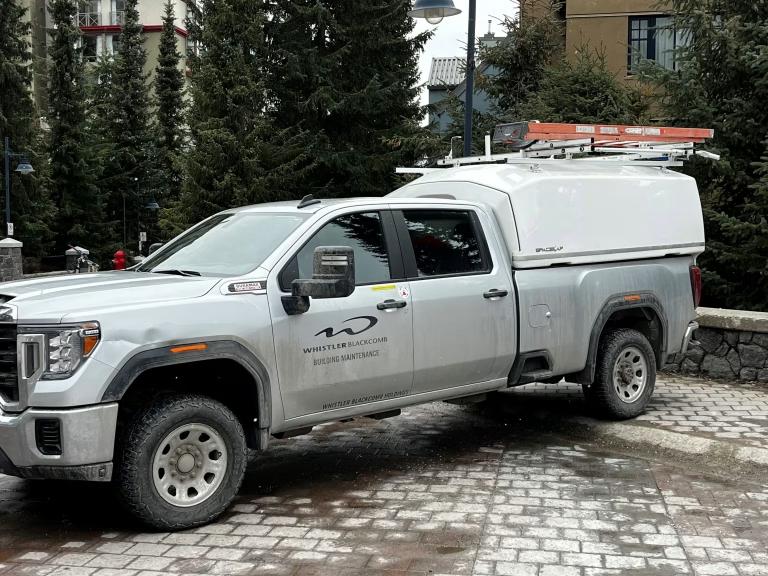
See it on real trucks
Spacekap units in service with our customers.

15. References & Further Reading
- U.S. Department of Energy fuel-economy and vehicle weight studies
- Industry studies on corrosion of steel under salt and winter conditions
- ASTM standards for fiberglass composite durability and marine-grade construction
- Fleet maintenance cost benchmarks from NAFA and industry reports